Even though the fields are green with grass, we are feeding hay to the ewes for a couple weeks after weaning the lambs to help the ewes dry down their udders. There are several hay feeders that we use and a couple of methods for delivery. The Gator works well, especially for transport during wet conditions when the heavy tractor would cause ruts in the field. Here the Gator is loaded with a 5-ft diameter bale, these were purchased for $40/bale from a guy near Lucedale when we thought we would run out of 4-ft diameter bales we make from our bahiagrass.

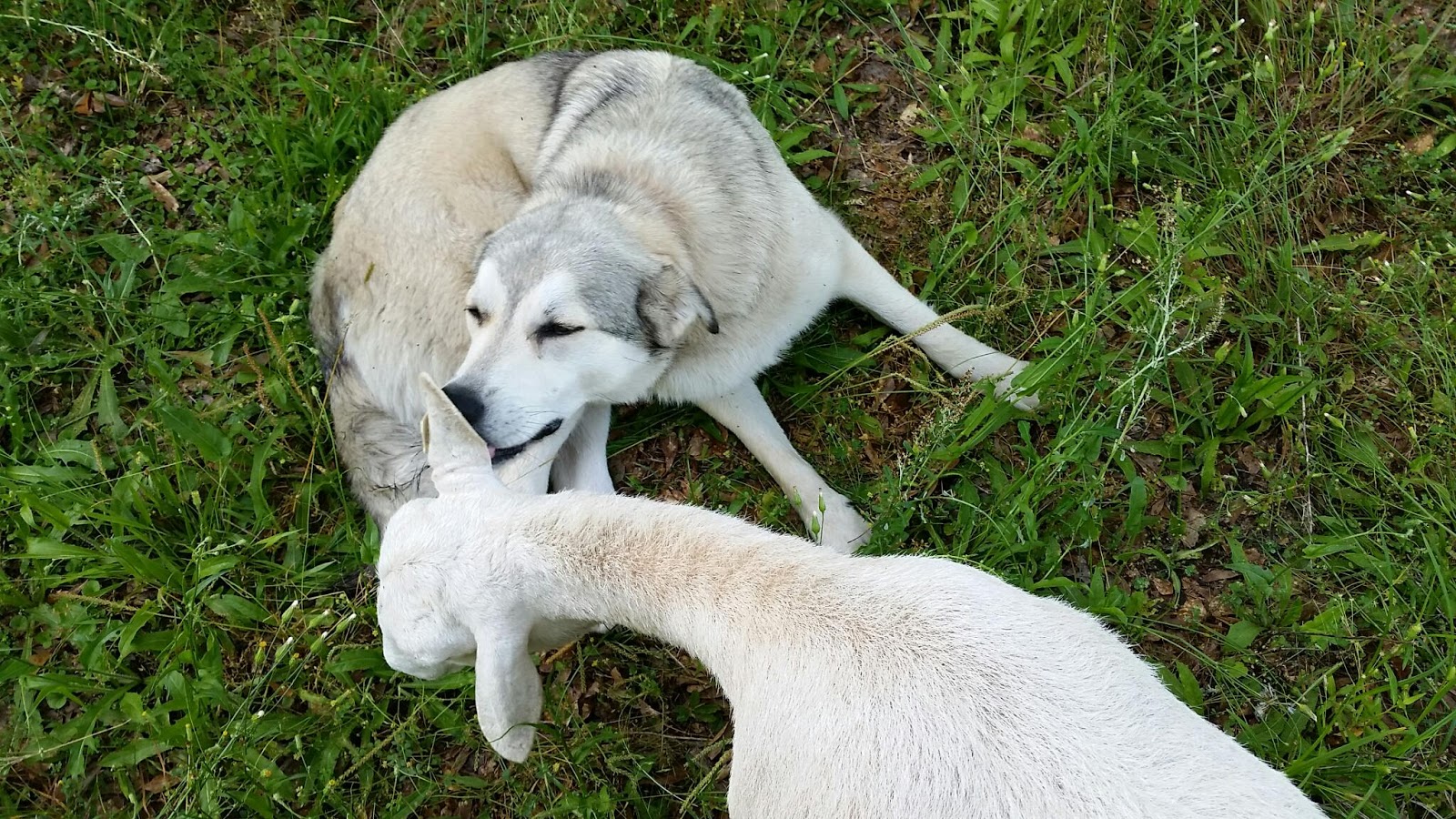
This is the original hay feeder that Jeffrey made years ago. It has been modified since then by opening up the front where Kratos is laying. The roof used to hinge up, but a wind storm lifted and flipped the roof over, snapping the posts. So, the roof was fixed in place on reinforced posts and we continued using it to feed the small square bales we made with our own baler. Using that baler was extremely labor intensive, about nearly killed us off in the middle of summer heat loading and unloading all those square bales by hand. Early last summer we acquired a used round baler, we made 4-ft diameter bales that worked well for feeding the sheep. That's when this old hay feeder was modified again to allow the tractor with hay spear to push a bale in directly. The 4-ft bales worked well; the 5-ft bales could be squeezed in with a little hay being pushed off at the edges.

We built a couple more hay feeders designed for our 4-ft diameter bales. It worked quite well to back the Gator up and role the bale in. The 5-ft diameter bales were more problematic. They were not even close to fitting.
To unload a 5-ft diameter bale I peel off several layers of hay, pushing it into the feeder with a pitch fork. Some ends up on the seats of the Gator making quite a mess.
After getting the diameter of the bale reduced, I tie it back on and move over to the adjacent feeder.
The reduced diameter roll is pushed into the feeder, leaving several bottom layers of hay on the Gator that I then pitchfork onto the feeders.
Of course the ewes all want to get at the hay, so the unloading is done in the midst them.
But the job gets done, the ewes are happy and I have a load of hay left in the Gator to take back up to the hay feeder with the lambs.
The lamb's hay feeder is on wheels so the Gator could move it about and was designed for feeding square bales loaded in by hand. With only round bales, we have to take hay from the the other feeders and pitchfork it into the mobile feeders. Even though the lambs have ryegrass and we are feeding them a grain mix, they like and eat the hay to give additional roughage to their rumens.
After we had to buy the additional 5-ft diameter hay (the normal size for hay put up around here), we built another hay feeder that was better sized for these larger bales. Since the fall ewe flock was finished eating hay, I moved that in with the spring ewe flock. It worked very nicely. Just backed the Gator up and rolled the bale in with no fuss at all.
The netting that contains the hay is cut at the back of the Gator and peeled back over the top of the bale. The bale then rolls off the netting as the bale roles into the feeder. This is a much cleaner hay delivery for these 5-ft bales than with the feeders designed for our 4-ft bales. However, since we used all of the 4-ft bales, I and the sheep are thankful to have the 5-ft bales.